Связаться с нашей командой
Связаться с нашей командой
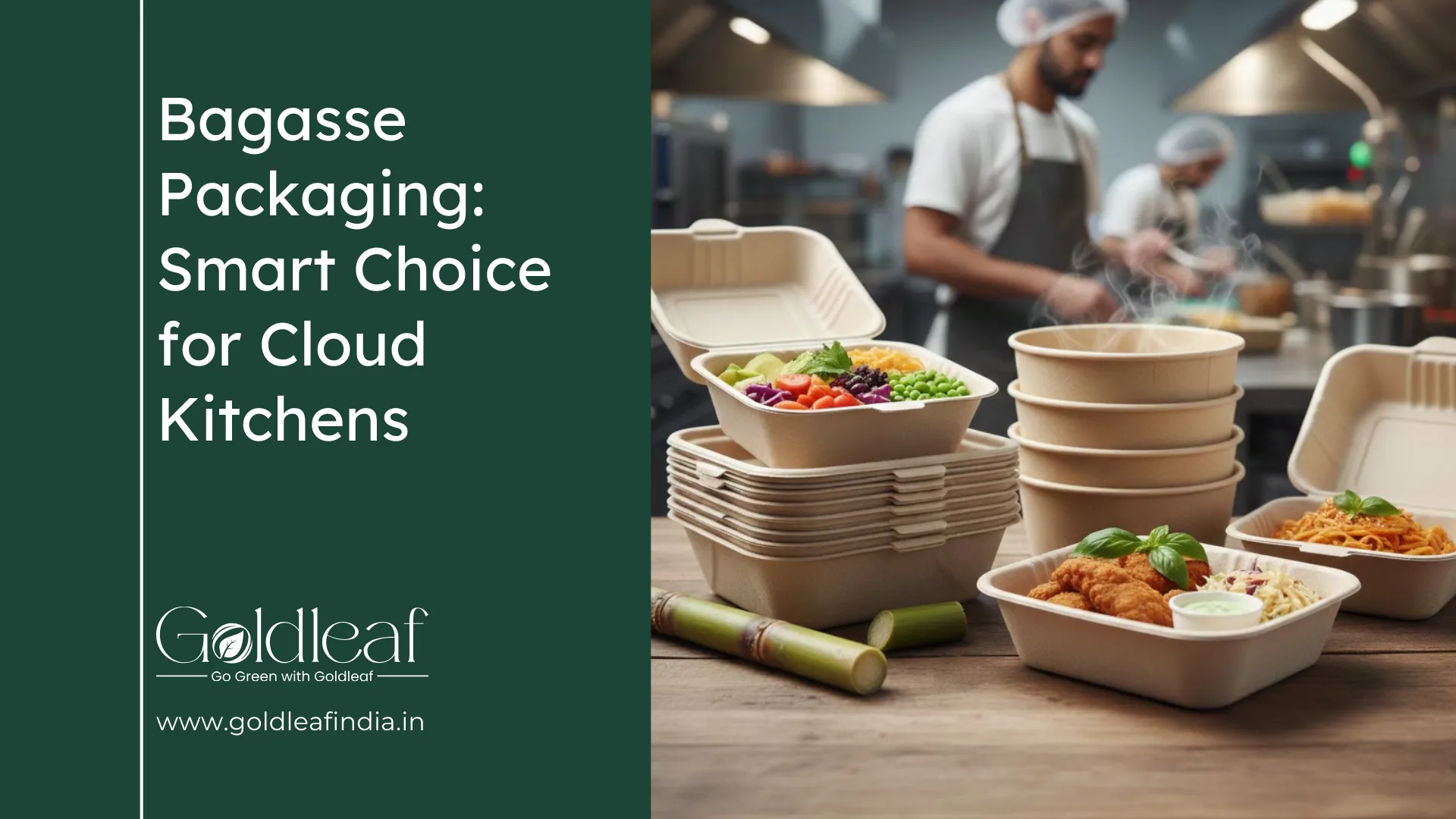
The cloud kitchen industry is booming, projected to reach $71 billion by 2027. But behind every delivered meal lies an uncomfortable truth mountains of plastic waste piling up in landfills. Modern cloud kitchen operators face a triple challenge: controlling razor-thin margins, meeting eco-conscious customer expectations, and standing out in an oversaturated market.
The answer? Bagasse packaging. From sturdy bagasse plates that handle your heaviest biryanis to leak-proof bowls perfect for curries, this sugarcane-based innovation is transforming how forward-thinking food businesses package their offerings. Cloud kitchens that have made the switch aren't just reducing their environmental footprint they're seeing measurable improvements in customer loyalty and order values.
Companies like goldleafindia are leading this revolution, manufacturing complete ranges of bagasse packaging that prove sustainability and performance aren't mutually exclusive. Let's explore why this material is becoming the go-to choice for delivery-focused restaurants.
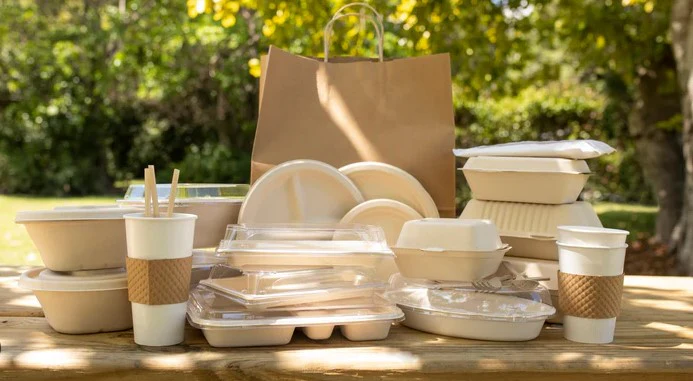
Bagasse packaging is made from the fibrous residue left after extracting juice from sugarcane known as sugarcane bagasse. Instead of burning or discarding this agricultural waste, it’s molded into plates, bowls, clamshells, and containers that replace single-use plastic.
Here's what makes bagasse food packaging special:
Made from 100% natural sugarcane bagasse packaging waste: Turning agricultural residue into valuable products
Completely biodegradable and compostable: Breaks down in 60-90 days in commercial composting
Microwave-safe and freezer-friendly: No harmful chemicals leach into food when heated
Heat-resistant up to 200°F (95°C): Handles hot gravies, soups, and freshly cooked meals
Naturally oil and leak-resistant: No plastic or wax coating needed
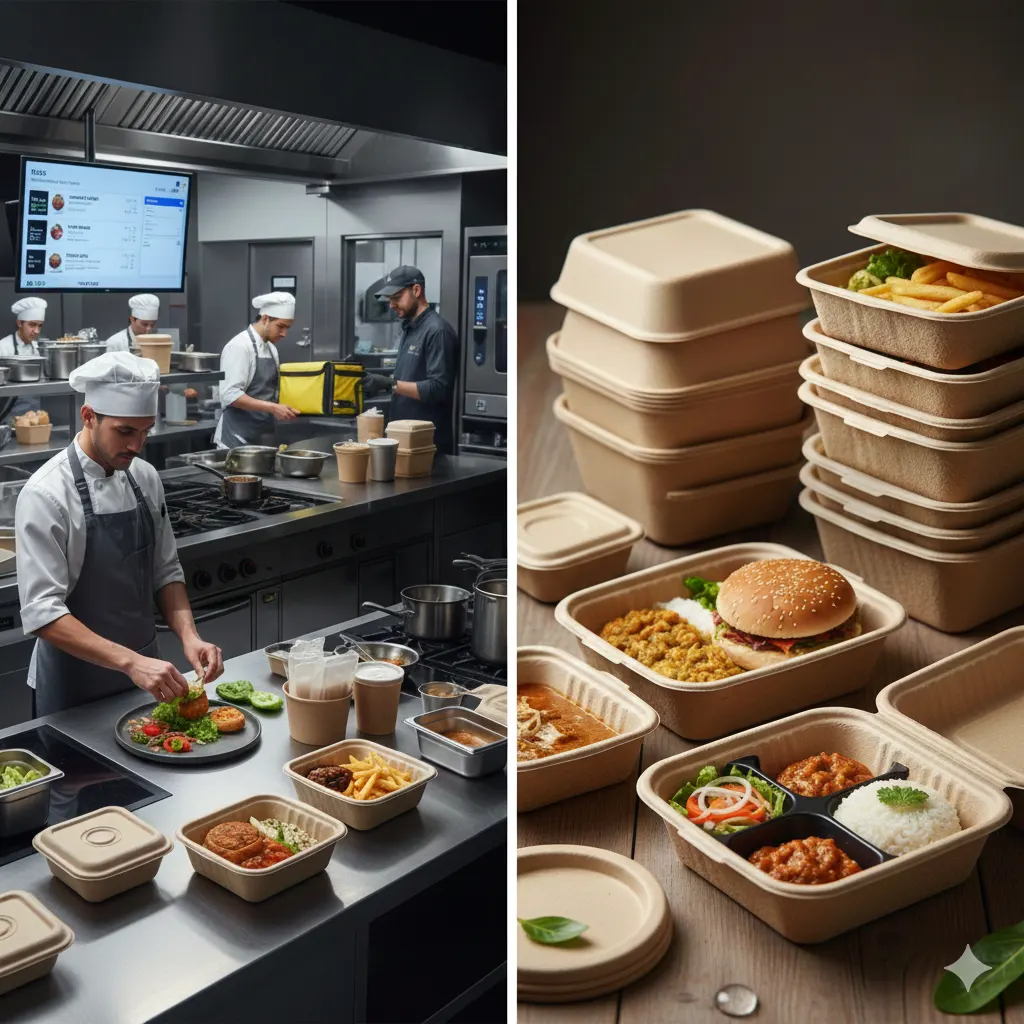
The rise of cloud kitchens also called CloudKitchens has changed food delivery dynamics worldwide. These kitchens operate without dine-in spaces, focusing entirely on preparing and dispatching meals efficiently. With high order volumes and delivery-centric operations, packaging becomes a critical component of brand reputation and customer satisfaction.
Here’s why bagasse packaging perfectly complements the cloud kitchen model:
Sustainability with scalability: Cloud kitchens can meet eco-regulations while maintaining cost efficiency.
Enhanced food experience: Bagasse food packaging retains heat and freshness, ensuring dishes arrive in perfect condition.
Positive brand perception: Customers increasingly prefer brands that use compostable and sustainable packaging.
Regulatory compliance: Many cities now mandate alternatives to plastic bagasse packaging helps brands stay ahead of environmental norms.
For any cloud kitchen, choosing eco-friendly materials like bagasse packaging is not just ethical it’s also strategic.
Switching to bagasse packaging offers a blend of performance and sustainability that few materials can match.
Microwave & freezer safe: Perfect for hot or cold dishes.
Water and grease resistant: Keeps food intact during long deliveries.
Odor and taste neutral: Maintains the dish’s true flavor.
Fully compostable: Decomposes within 60–90 days in a composting environment.
Strong and lightweight: Easy to transport and store.
Customizable: Suitable for branding and logo printing.
|
Feature |
Bagasse Packaging |
Plastic Packaging |
Paper Packaging |
|
Eco-friendly |
100% compostable |
Non-biodegradable |
Partially recyclable |
|
Heat resistance |
Up to 200°C |
May melt |
May deform |
|
Food safety |
BPA-free |
Often contains toxins |
Safe |
|
Strength |
High |
Moderate |
Low |
|
Brand perception |
Eco-conscious |
Outdated |
Average |
With this blend of sustainability and practicality, bagasse food packaging is rapidly becoming the industry standard for environmentally responsible cloud kitchens.
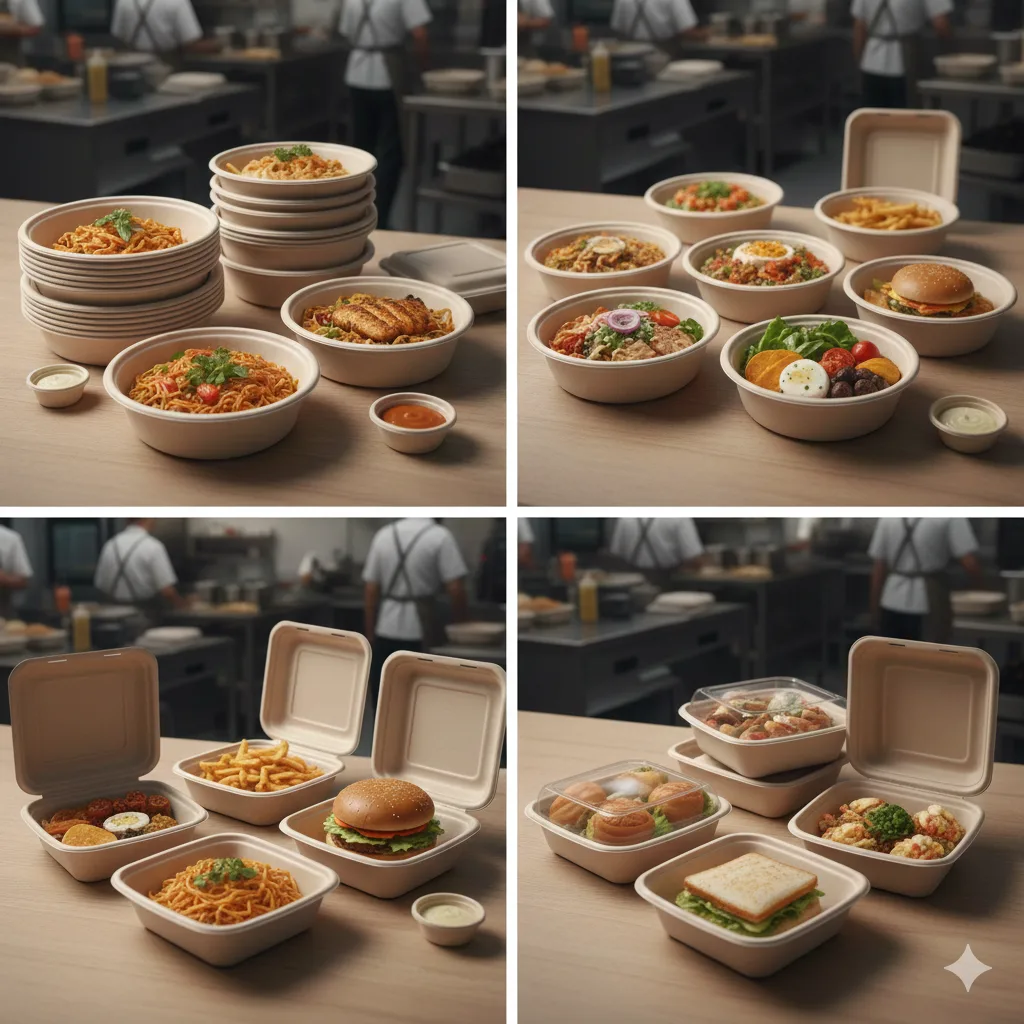
At Goldleaf India, a wide range of bagasse packaging products are designed specifically for cloud kitchens and delivery-based businesses. Each product type serves a different purpose, catering to diverse cuisines and portion sizes.
Bagasse plates and compartment plates are ideal for full meals, combos, or thali-style servings. They’re sturdy, leak-proof, and perfect for portion control.
Benefits:
Suitable for dine-in alternatives and food combos.
Compostable and microwave safe.
Keeps meals fresh during transit.
Whether you’re serving salads, gravies, noodles, or desserts, bagasse bowls offer the ideal balance of form and function.
Why cloud kitchens prefer them:
Retains heat and prevents sogginess.
Stackable and compact for delivery riders.
Complements both Indian and international cuisines.
Bagasse clamshells are among the most popular bagasse takeaway containers. They’re easy to close, mess-free, and perfect for burgers, wraps, sandwiches, and combo meals.
Advantages:
Secure snap-fit lid for safe deliveries.
Grease and spill resistant.
100% compostable and food-safe.
Bagasse boxes and bagasse food containers are versatile for curries, rice bowls, and premium meals. Many cloud kitchens prefer them for their aesthetic appeal and sturdiness.
Benefits:
Retains food quality over long distances.
Works well for branding and labeling.
Stackable design for efficient storage.
Sustainability isn’t just about meals even drinks deserve attention. Compostable tea cups made from bagasse packaging are lightweight, durable, and plastic-free. Perfect for hot beverages, these cups add value for eco-conscious cafés and kitchens.
Transitioning to bagasse packaging is easier than most cloud kitchens expect. Follow this streamlined plan to switch without operational disruption.
Calculate weekly/monthly volume for all product types (plates, bowls, containers)
Map menu items to correct packaging (biryani → 9" bagasse plates, soup → 500ml bowls)
Identify peak demand and seasonal changes
Document current packaging costs for comparison
Request sample kits from suppliers
Test with actual menu items hot, cold, oily, liquid foods
Run real delivery-condition tests
Collect honest feedback from staff, delivery partners, and select customers
Compare bulk pricing vs your current packaging expenses
Consider higher order values (customers often pay 5–10% more for sustainable options)
Estimate waste disposal savings (compostable vs landfill)
Factor in brand value and customer retention over 6–12 months
Verify food-grade certifications (FDA, BIS)
Ensure consistent supply and stock availability
Check customization options (logo print, custom sizes)
Review MOQs and delivery timelines
Working with established manufacturers like goldleafindia offers consistency, reliable supply, and complete solutions from compartment plates to bagasse clamshell containers.
Train staff on correct packing techniques
Update website/app with sustainability messaging
Add a small note inside orders explaining the switch
Promote the transition on social media
Track customer feedback and refine as needed
Most cloud kitchens complete the shift within 2–4 weeks, starting with high-volume items and then expanding to the full menu.
When it comes to responsible manufacturing, Goldleaf India leads the way. With a strong focus on sugarcane bagasse packaging, the company has redefined how sustainable materials can be used at scale.
Goldleaf India’s strengths include:
State-of-the-art production facilities ensuring consistent quality.
In-house quality testing for heat resistance, durability, and hygiene.
A diverse portfolio from bagasse plates and bowls to clamshells and compartment plates.
A mission-driven approach to replace plastic with renewable alternatives.
By combining technology, sustainability, and design, Goldleaf India is empowering the future of eco-conscious packaging.
Beyond business benefits, the environmental impact of switching to bagasse containers is substantial and measurable. For cloud kitchens processing 100-200 orders daily, the numbers add up quickly.
Impact by the Numbers:
A mid-size cloud kitchen switching to bagasse packaging can eliminate 50,000+ plastic items from landfills annually that's roughly 1,200 kg of plastic waste prevented
Bagasse decomposes in 60-90 days in commercial composting facilities, vs 500+ years for conventional plastic containers
78% of millennials and Gen-Z consumers (your core delivery demographic) actively prefer ordering from eco-conscious restaurants
Average customer willingness to pay premiums: 5-10% more for meals delivered in sustainable packaging
Zero toxic chemicals released during decomposition – bagasse returns nutrients to soil instead of leaching microplastics
Carbon footprint reduction: Producing bagasse food containers generates 75% less CO2 compared to plastic manufacturing
But statistics only tell part of the story. The real-world impact shows up in customer reviews: "Love that they use eco-friendly packaging!" Ratings improve. Repeat orders increase. Brand perception shifts from "just another cloud kitchen" to "restaurant that cares."
In an industry where differentiation is increasingly difficult, your commitment to bagasse food packaging becomes a tangible competitive advantage. It's not greenwashing when customers can literally hold the evidence in their hands.
Upgrade Your Kitchen Packaging
In a world where convenience meets conscience, bagasse packaging is truly the smart choice for cloud kitchens. It supports sustainability goals, improves customer experience, and aligns with future-ready food delivery models.
By choosing Goldleaf India, cloud kitchens can switch to innovative, eco-friendly solutions that reflect both quality and care for the planet. Sustainable change starts with the packaging and Goldleaf India is leading that change one container at a time.
Bagasse packaging is crafted from the fibrous residue of sugarcane, molded into eco-friendly products like plates, bowls, and boxes.
It’s compostable, toxin-free, and helps reduce landfill waste unlike plastic, which takes centuries to decompose.
Yes, bagasse boxes and bagasse containers are both microwave and freezer safe, perfect for hot or cold foods.
Absolutely! Using bagasse takeaway containers can cut waste management costs and enhance brand perception.
Typically, sugarcane bagasse packaging decomposes within 60–90 days in a composting environment.
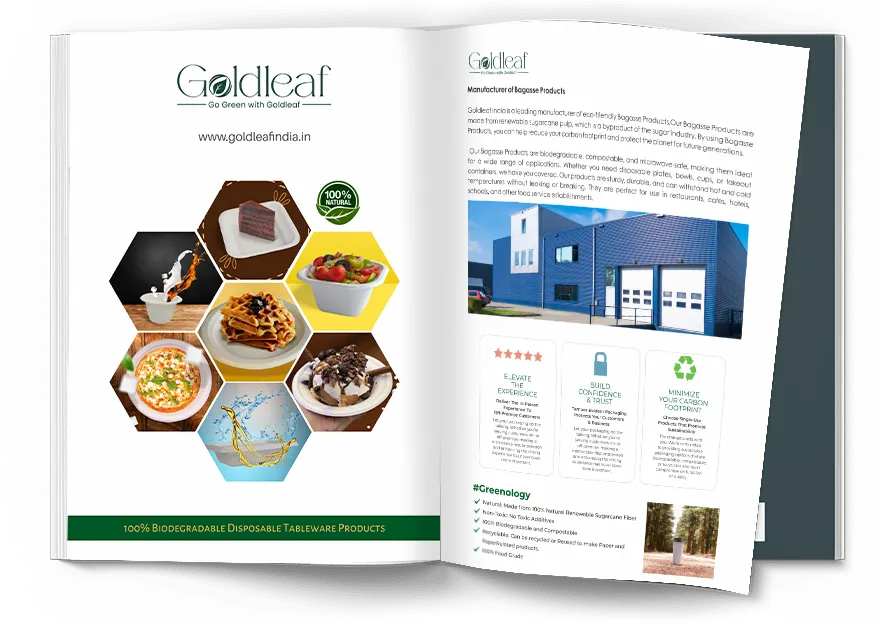
Goldleaf India Является ведущим производителем экологически чистых продуктов Bagasse. Наши продукты Bagasse изготовлены из мякоти сахарного тростника, которая является побочным продуктом сахарной промышленности.
© 2024 , Goldleaf ,
Все права защищены.
Made & Managed by Lightlink Solutions